What’s your Mission as Freelancer?
When I speak to freelancers looking for work, I ask them to tell me a little bit about themselves. A lot of the time they start to tell me about what they do. And the longer I give them, the more skills they talk about, the more tasks they’re capable of taking on. As the list grows, they get further and further from what it is they are really passionate about doing.
Similarly, when I’m looking at their showreels or websites, there’s often a disconnect between the work a freelancer says they do and their showreel. And often, the description they give themselves doesn’t match what they actually do for their clients. The relationship between the work they do, the work on their showreel and the work they want to to looks something like this:
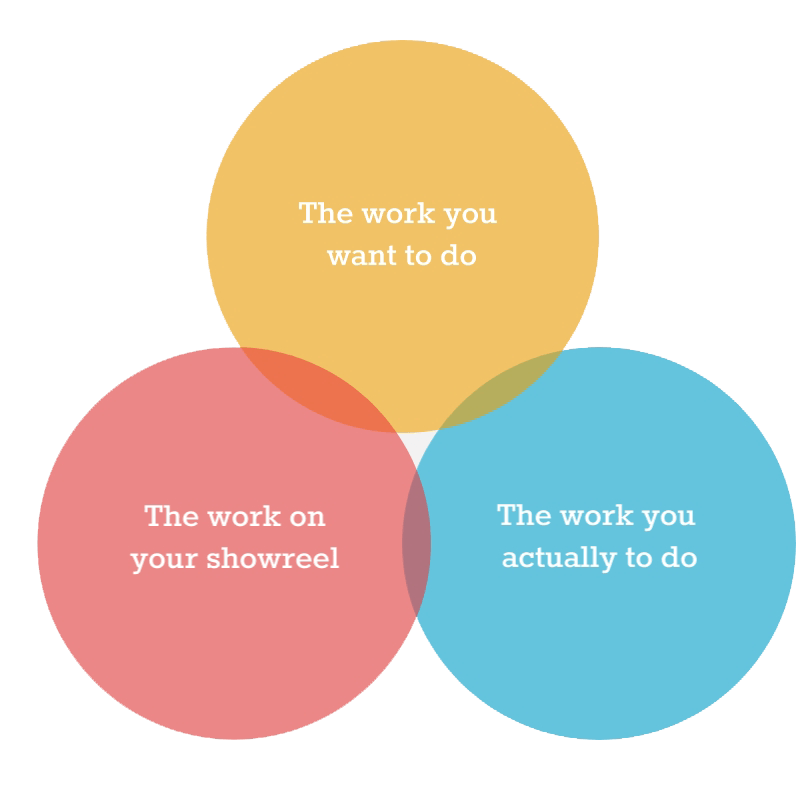
When I look at your work, I don’t know which part I’m looking at. The truth is, I also know that freelancers more often than not have a burning ambition for one particular kind of work. They might not be doing that work yet, but it’s what they have their heart set on.
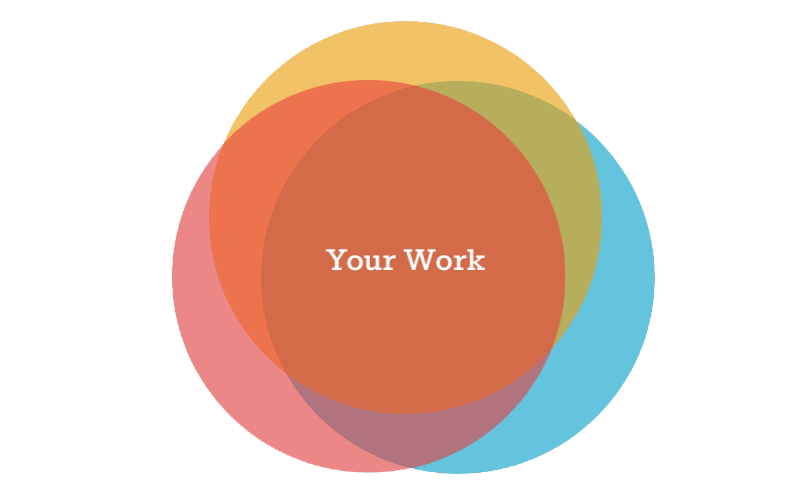
What you need is a Freelancer Mission Statement to really help you focus what you WANT to do, rather than what you think you can get people to pay you for right now, so that you can get to the position where that diagram looks like this:
 Why you need a Freelancer Mission Statement
Your Freelancer Mission Statement is a tool to help you focus so you’re clear about what you offer, and it’s what you want to do in your career.
To write a mission statement, you need to answer these questions:
- What do you do?
- How you do it?
- Who you do it for?
- Why you do it?
- How does it make you money?
What do you do?
Are you an animator? And editor? Or camera person?
What kind of one are you? What do you specialise in? What do you have a knack for?
Dramas? Product shoots? Explainer videos? Character design?
How do you do it?
Are you the fastest? Is attention to detail your thing? Which software do you favour?
Or it might be more technical like which kinds of camera you use, or the particular software you know.
Who do you do it for?
Do you work for broadcast television? Feature films? Do you love working with brands?
Or maybe you like working with Start Ups or Agencies?
Why do you do it?
What drives you to do this? What do you find fascinating about it?
What gives you satisfaction when the project is done? What do you want your clients to achieve?
How does it make you money?
Crunch time. How are you going to turn all of the above into cold hard cash?
What is it that people pay you for?
Why should they part with money for what you do?
How will that happen? Do they buy a product? Do they hire you by the day?
Writing it up
When you’ve answered these questions, write up a paragraph of prose. Keep it short and snappy, two maybe three sentences.
If you do two jobs, don’t mix it up. If you’re a director who also works camera, write one as a director and a separate one for your work as a camera person.
The Endgame
Set the FMS aside for a day or two and come back to it fresh. Ask yourself, is this the person you want to be in two year’s time?
If it fills your heart with excitement, then great.
If there’s even a shadow of a doubt, then revise it.
How to use your Mission Statement
For me, your mission statement should be like the rudder of a ship. No matter which way the currents take you, your Mission Statement is there to guide you back in the direction you want to go. Just as the person at the helm of a sailing ship moves the rudder to traverse the waves ahead, it’s there to take you where you want to go.
And of course, this Mission Statement will flex and change as your career grows, but keep it two year’s ahead of where you are.
What can you do with your Mission Statement?
- print it out and stick it by your desk so you’re reminded of it
- put the copy on your website
- add it to your recruitment website profile
- put it on your LinkedIn
When can you use your Mission Statement?
- read it before you write a job application
- refer to it before you have an interview
- use it when making introductory calls
- say it when introducing yourself at networking events
Of course, there are many other times you might use it. And each time it will help your focus on communicating to your prospective employer what you’re really passionate about. They will feel that passion, and understand where your interest lie.